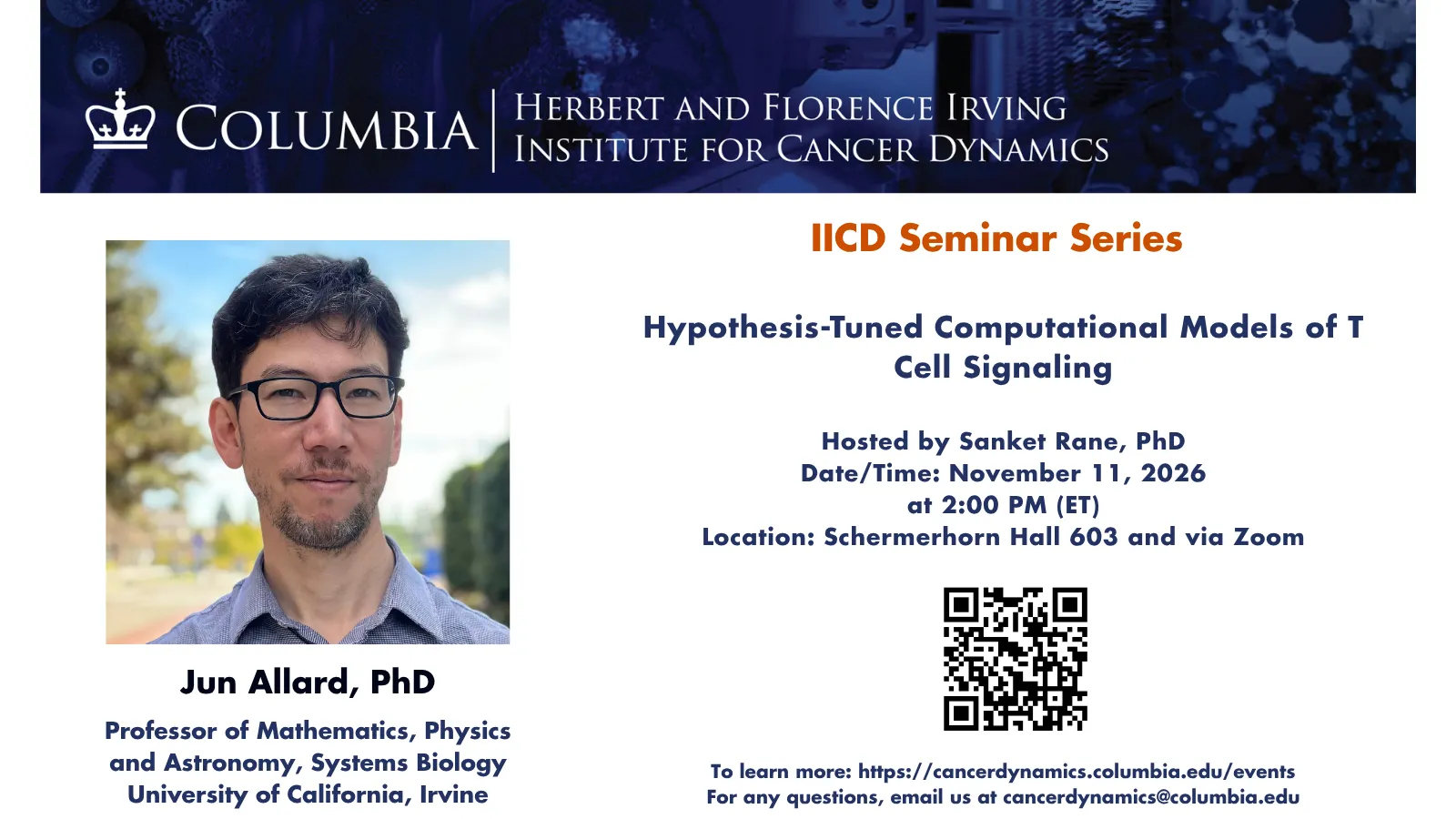
The Herbert and Florence Irving Institute for Cancer Dynamics will continue its seminar series on the topic of mathematical sciences underpinning cancer research. The monthly seminars take place on the second Wednesday of the month, 2:00-3:00 PM EST. The presentations are open to the Columbia community (in person and online) and to researchers outside Columbia (via Zoom).
On Wednesday, November 11 (2:00 PM ET), IICD welcomes Dr. Jun Allard from University of California Irvine. Seminar hosted by Dr. Sanket Rane. The seminar will take place in person in Schermerhorn Hall 603 (Morningside Heights campus). If you wish to attend the seminar remotely, please register using the following link: https://columbiauniversity.zoom.us/meeting/register/XGb3gk99TiiabqsDL-qcwQ
Title: Hypothesis-Tuned Computational Models of T Cell Signaling
Abstract: A keystone goal of mathematical biology is to develop quantitative, predictive models of how cells respond to signals from ligands. This includes the many cases where a cell is confronted with multiple ligands simultaneously, and the effects of each ligand is non-linear (meaning, for example, twice the concentration of ligand does not provoke twice the response). The need is particularly acute for the T Cell, a key immunological decision-maker. T Cells process signals from antigen and a zoo of stimulatory and inhibitory co signaling ligands, like PD-L1 and CD58, over different timescales (some ligands give rise to distinct responses depending whether they are presented for seconds, hours, or days). For the T Cell, decades of research have contributed knowledge about mechanisms and modules that make up the signal processing system, for example, how multiple phosphorylation of the T Cell receptor contributes to kinetic proofreading. Efforts to develop quantitative models must face a trade-off between interpretability (e.g., whether they support or refute specific hypotheses, and how readily they incorporate existing knowledge) and quantitative accuracy (which often disfavors interpretability). We have developed a modeling approach, along with compatible learning algorithms, in which we tune the level of model flexibility to match the hypotheses being explored. The models are technically harder for learning algorithms than either high-flexibility (unconstrained, high-dimensional) or low-dimensional (e.g., mass-action or classical) models, but allow more precise quantitative prediction without sacrificing modularity and the intuition that comes with prior hypotheses. We demonstrate two examples: T cell responses to pulsed antigen, which exhibit band-stop and low-pass filtering, and identifying where the co-signaling receptors act in the T cell receptor pathway.
Bio: Jun Allard is a Professor of Mathematics, Physics and Astronomy, and Systems Biology at the University of California, Irvine. His group builds quantitative, predictive models of cells using polymer physics, stochastic processes, and high-dimensional statistical learning. Current projects include understanding how T cells activate in response to signals. His group also builds polymer models that predict how 3D genome contacts reorganize when immune cells are activated, and studies the mechanics of the cytoskeleton and of intrinsically disordered "tethered" signaling proteins. He recently held a Guy Newton Fellowship at the Sir William Dunn School of Pathology, University of Oxford.
If you would like to meet one-on-one (possibly via Zoom) or attend the lunch or dinner with the speaker, please contact the event organizer.