
Echidna: A New Framework for Exploring Tumor Evolution and Gene Activity
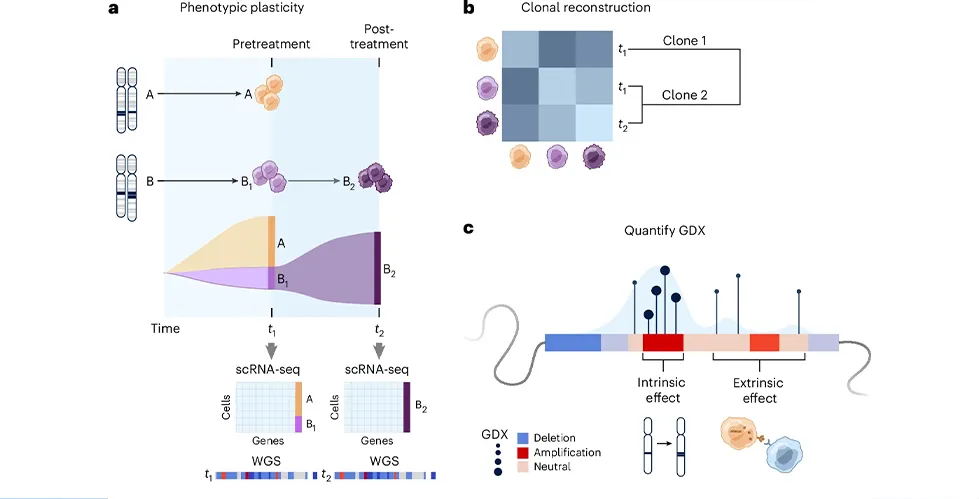
The Azizi lab at the Irving Institute for Cancer Dynamics, in close collaboration with the Izar lab at Columbia University Irving Medical Center, recently developed Echidna, a new statistical (Bayesian) model that helps researchers distinguish the effects of DNA copy number from other factors affecting gene activity. Their study was published in Nature Methods.
Distinguishing Genetic and Non-Genetic Influences on Cancer Cells
Cancer cells frequently gain or lose large segments of DNA. An increase in the number of gene copies can lead to increased transcription, a phenomenon known as the “gene dosage effect.” However, cells can also change their behavior in response to environmental changes. Distinguishing these two causes is complex, because measuring both DNA and RNA in the same single cell is expensive and often impractical for patient samples.
Integrating DNA and RNA Data with Echidna
To overcome this issue, IICD researchers developed “Echidna, a Bayesian model that combines two widely available data types from the same tumor: single-cell RNA sequencing and standard bulk whole-genome sequencing,” explains author Dr. Joy Linyue Fan.
Echidna’s underlying approach is straightforward: the method estimates how gene activity in individual cells relates to the number of copies of each gene carried by their respective clones, using bulk whole-genome sequencing to guide these estimates. “It reconstructs the tumor’s clones, estimates the DNA copy number of each, and measures how strongly DNA dosage drives gene activity, including across multiple time points,” continues Fan.
Improving the Accuracy of DNA Copy Number Inferences
Echidna inferred copy number alterations (or CNAs) more accurately than widely used existing methods. With Echidna, researchers now have a more general tool to distinguish genetic from non-genetic causes of cell behaviors.
As author Mingxuan Zhang elaborates, “Compared against ‘ground truth’ single-cell DNA data, Echidna reconstructed clone structure and copy-number profiles more accurately than existing tools. It tracked how clones expanded or shrank over time in patient samples. It also distinguished genes whose activity is driven mainly by DNA dosage from those driven by other factors, which gave insights into treatment resistance.”

Expanding Applications in Cancer Research
Echidna is an open-source computational tool compatible with commonly used sequencing data, enabling researchers to analyze existing clinical datasets without the need for expensive single-cell DNA sequencing.
As Dr. Elham Azizi, one of the corresponding authors, notes: “It applies beyond melanoma to any cancer, or other system, where DNA copy number varies. It helps researchers prioritize genes that tumors depend on because of extra DNA copies, which are potential therapeutic targets.”
Looking Ahead
The researchers plan to apply Echidna to additional cancer and treatment types. Specifically, they wish to expand Echidna to incorporate spatial profiling data, which provides information about where cells are located within tumors, as well as other molecular data types.
Publication Details
The paper was published in Nature Methods in November 2026 (DOI: 10.1038/s41592-026-03279-4). The work was an ongoing collaboration between the Azizi lab and the Izar lab at Columbia University Irving Medical Center. The study was led by IICD researchers Joy Linyue Fan and Mingxuan Zhang and involved many other IICD researchers.
Data and code are publicly available. Echidna software: github.com/azizilab/echidna