
Dr. Sanja Vicković: Envisioning the Future of Spatial Transcriptomics and Multi-omics
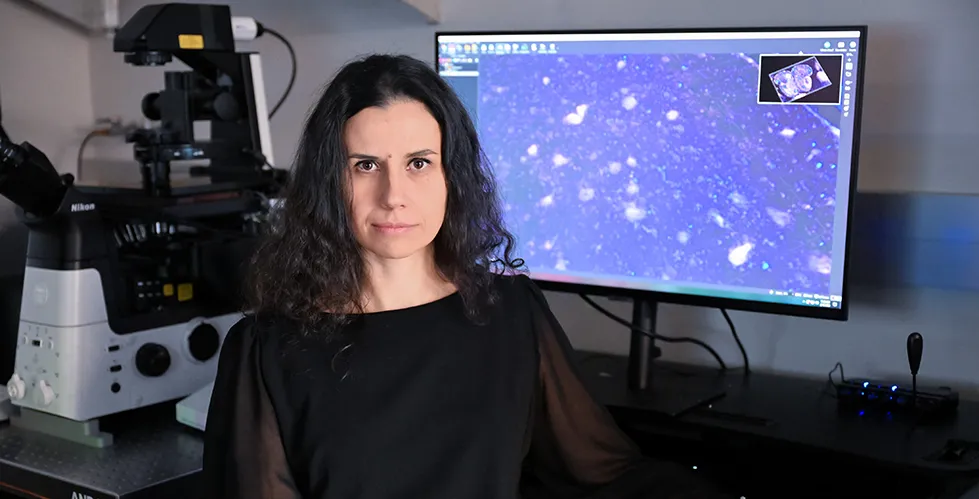
“When I started my lab, I was deeply motivated by one fundamental question,” reflects Sanja Vicković, “how do cells coordinate their behavior in space to give rise to tissue function — and dysfunction?”
Since 2022, this question has informed the scientific vision of the Vicković Lab, led by Dr. Sanja Vicković. A pioneer of spatial transcriptomics research, she serves as a Core Faculty member at the New York Genome Center and Assistant Professor of Biomedical Engineering (IICD) at Columbia University.
Advances in spatial transcriptomics have redefined research possibilities for the Vicković group. “Over the past few years, as cellular atlases have rapidly expanded, including many contributions from our group, it has become clear that mapping cell identities is only the beginning,” Dr. Vicković shares.
The Vicković group at the New York Genome Center is an innovative hub of molecular biologists, biomedical engineers, mathematicians, and more. Much like her evolving research, Dr. Vicković approaches mentorship with careful thought and a long-term vision for her trainees’ futures in science. “I strive to create an environment that is inclusive, supportive, and intellectually rigorous,” she says. “One that builds confidence while fostering curiosity, critical thinking, and methodological fluency.”
Today, Dr. Vicković and her mentees are building tools that allow researchers to interrogate function directly in intact tissues, and to accelerate the transition from observation to mechanism. The group develops RNA-sensing spatial technologies to better understand relationships between cellular states.
“In simple terms, our lab builds very detailed ‘maps’ of tissues,” Dr. Vickovic explains. “These maps show which genes are active, where different cells sit, and how they interact with their neighbors.” The ‘tissue maps’ described by Dr. Vickovic are used to study cancer, aging, and immune responses. These maps make it possible to study molecular signals and the physical organization of cells, in normal conditions and when disease occurs. These research findings will lead to better diagnostics and therapies.
So how will Dr. Vicković’s research contribute to future cancer diagnostics and treatment? “The long-term vision is a next-generation digital pathology framework that enables predictive modeling of tumor microenvironments and supports more precise, personalized therapies for colorectal cancer patients,” she tells us. Her group maps the interaction of tumor cells and immune cells, then integrates high-resolution imaging, computer vision, and deep learning to assess treatment sensitivity, resistance and outcome.
The convergence of modalities in spatial transcriptomics has energized the Vicković group. High-resolution imaging, improved molecular detection, and advanced computational modeling enables the lab to study tissues at a systemic level.
“We aim to improve statistical power, interpretability, and ultimately the reliability of multi-omic discoveries,” Dr. Vicković concludes. “This tight integration between wet-lab innovation and computational modeling is key to translating technology into impact.”