
Postdoc Profile: Ren-Yi Wang, PhD
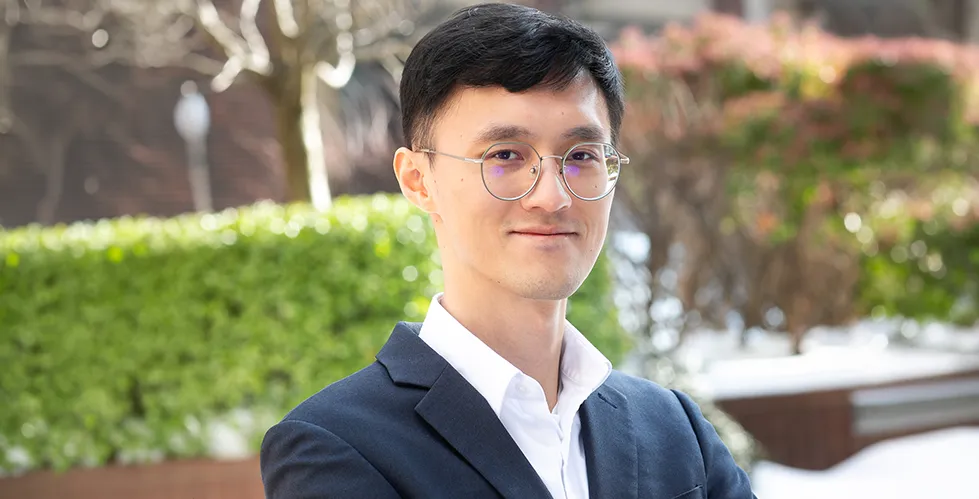
Dr. Ren-Yi Wang is a Postdoctoral Research Scientist at Columbia University’s Herbert and Florence Irving Institute for Cancer Dynamics (IICD), where he is mentored by Professor Simon Tavaré. His research focuses on developing mathematical models of cancer dynamics and computational methods for estimating key biological parameters from data.
Ren-Yi’s path to cancer research began with an early fascination with mathematics and was later shaped by his own experience with cancer. “In eighth grade, I became fascinated by mathematics after my teacher assigned us a problem illustrating why an arbitrary angle cannot be trisected using only a straightedge and compass,” he recalls. “That experience inspired me to teach myself trigonometry and calculus. Then, in ninth grade, I was diagnosed with cancer, which motivated me to consider how my mathematical expertise could one day contribute to cancer research.”
That motivation followed Ren-Yi into his undergraduate studies at the University of California, Berkeley, where he began as a mathematics major. After taking a probability course, he added a second major in statistics and became increasingly interested in how mathematics could be applied to real-world questions.
“As I learned how statistics enables us to draw reliable conclusions from data, I became increasingly interested in applied research,” Ren-Yi explains. Inspired by both this growing interest and his personal experience with cancer, he continued his studies at Rice University, where he focused on stochastic models of cancer dynamics.
Today, Ren-Yi applies tools from stochastic processes and differential equations to investigate the mechanisms underlying cancer evolution, hematopoiesis, and neurogenesis. He is also interested in model criticism, the study of whether mathematical and statistical models adequately capture the processes that generated observed data.
In one of his current projects in collaboration with Dr. Khanh Dinh, Ren-Yi is developing a flexible mathematical framework for studying extrachromosomal DNA (ecDNA) dynamics. Their model accommodates different ways ecDNA can be distributed as cells divide and variations in how those differences affect cell fitness. Importantly, the framework also allows researchers to efficiently estimate key parameters without relying on computationally intensive simulations.
The framework can be applied to both single-cell and bulk sequencing data. Ren-Yi is also working to integrate the model with lineage-tracing technologies developed by Professor Matthew Jones’s group at MIT, with the goal of estimating when ecDNA populations first emerge.
At the same time, Ren-Yi is developing methods for identifying when a mathematical model may not adequately represent the biological process being studied. Cancer is extraordinarily complex, and models of cancer dynamics often involve calculations that are difficult or impractical to perform directly.
Biological data can also contain substantial noise, making it especially important to evaluate the reliability of a model before using it to draw scientific conclusions. Ren-Yi draws on methods from stochastic optimization to address this challenge.
For Ren-Yi, one of the most fulfilling aspects of research is what he calls “the unreasonable effectiveness of mathematics.”
“The most exciting moments occur when a mathematical model predicts a feature of a biological process that is later confirmed by biological evidence,” he says. “One recent surprise was our model’s prediction that the long-term distribution is independent of the composition of the initial cell population. Seeing that prediction borne out, and recognizing how unexpected it was to our collaborators, was especially rewarding.”
From the geometry problem that first sparked his fascination with mathematics to his own experience with cancer, Ren-Yi’s path has shaped his commitment to applying mathematical thinking to complex biological questions. By combining mathematics, statistics, and cancer biology, he hopes his research will contribute to a deeper understanding of cancer and, ultimately, help advance efforts to prevent and treat the disease.