
IICD Researchers Develop a More Robust Method for Visualizing High Dimensional Datasets
In a newly published study in PNAS, IICD researchers introduce a new method to visualize high dimensional datasets, making them easier to explore, understand, and interpret.
Overcoming Inaccurate Data Visualization
Existing methods, such as tSNE (t-Distributed Stochastic Neighbor Embedding) and UMAP (Uniform Manifold Approximation and Projection), are reduction algorithms that break down complex datasets to two or three dimensions. However, they can sometimes provide inaccurate visualizations by splitting a single cluster into several smaller ones or failing to show that different regions of the data are actually connected.
Developing EmbedOR, a More Robust Approach
To address the shortcomings of existing methods, Blumberg and colleagues developed a new approach that utilizes a mathematical concept called discrete curvature to more robustly identify and capture cluster structure within the visualization.
“We find that the utilization of discrete curvature in our visualization method indeed reduces the rate of fragmentation of connected regions of the data and reduces the rate with which clusters are not missed in the visualizations,” explains lead author Tristan Luca Saidi.
Applying EmbedOR to Single-Cell Genomics
Visualization tools such as tSNE and UMAP are widely used to explore large single-cell RNA sequencing datasets and support the identification of new cell types. Since EmbedOR is designed to preserve connected groups of cells in the visualization, it is less likely to split biologically similar cells into separate clusters. This could help scientists identify new cell types and better understand the gene expression patterns that distinguish them.
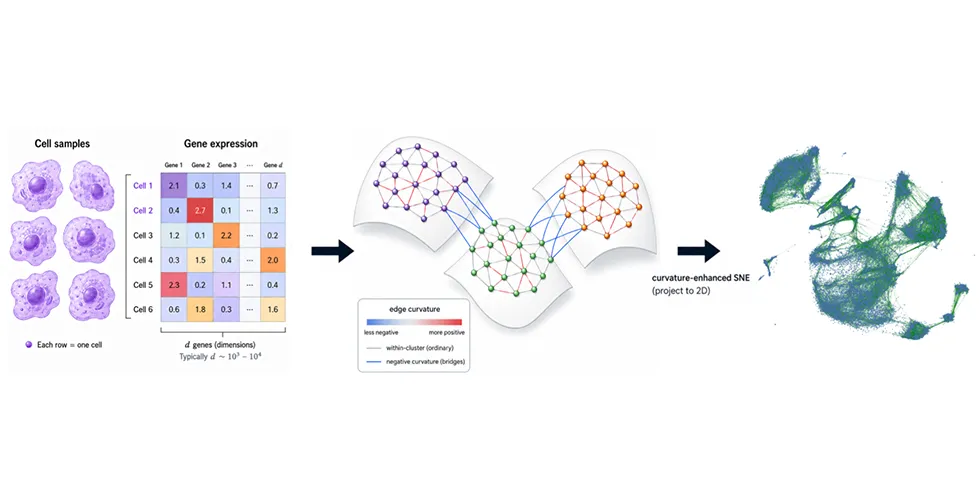
“We believe that our method will aid scientists in discovering new cell types and analyzing the genomic signatures of existing ones by providing a visualization method that more accurately represents the connectivity of the original data,” shares Blumberg.
What’s Next
Researchers now want to further improve the scaling power of EmbedOR and apply the algorithm to the largest available single-cell RNA sequencing datasets. They are also exploring how to apply the method to various single-cell datasets to infer new cell types and gene-level dynamics.
Publication Details
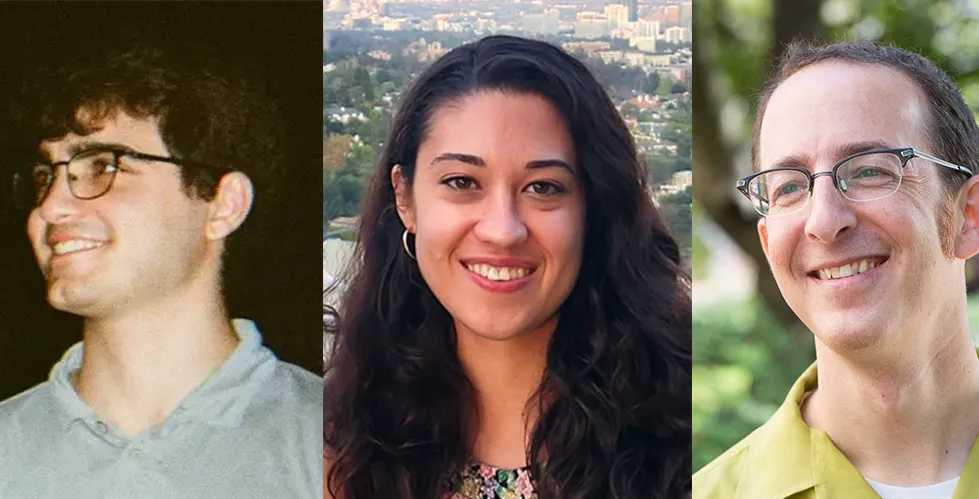
The paper was published in Proceedings of the National Academy of Sciences in July 2026 (DOI: 10.1073/pnas.2509171123). The work was a collaboration between the groups of Andrew Blumberg (Irving Institute for Cancer Dynamics and Departments of Mathematics and Computer Science) at Columbia University and Bastian Rieck (Professor of Machine Learning) at the University of Fribourg. The study was led by IICD researchers Tristan Luca Saidi and Abigail Hickok.