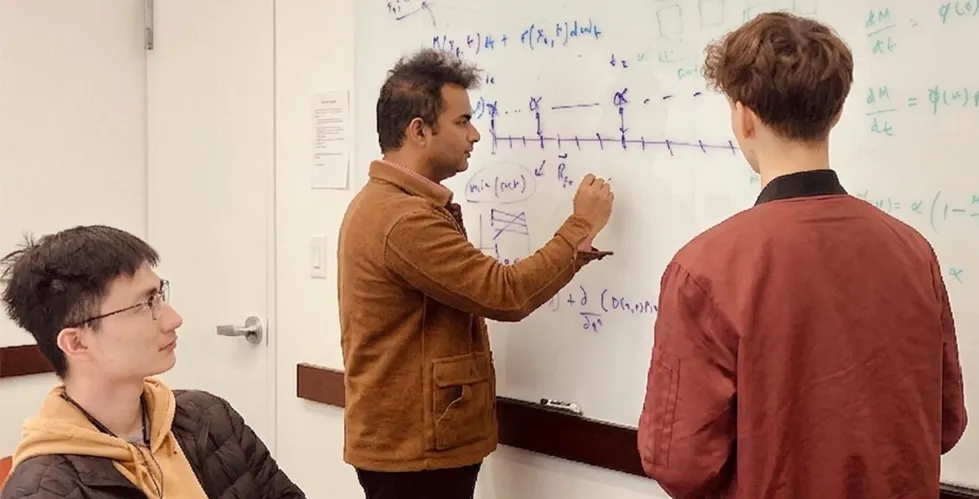
Meet Dr. Sanket Rane, Associate Research Scientist in the Irving Institute for Cancer Dynamics. Dr. Rane’s career began in traditional immunology, but his curiosity about cancer, specifically, led him into quantitative research, building models to predict immune responses. The overarching goal of his research is to make cancer immunology more mechanistic– “more like using a GPS and less like reading a paper map,” he says— to create customized, specific treatments based on how an individual’s cells are acting.
The particular focus of the Rane Lab is modeling cancer response dynamics, using math to better understand how the immune system reacts when it encounters a tumor.
“In simple terms, we take 'snapshots' of cell populations and use mathematical models to patch them together into a movie,” Dr. Rane describes. “This allows us to see how those populations, and the individual cells within them, change, adapt, and evolve over time.”
A recent discovery regarding regulatory T cells (Tregs) revealed that the cells follow a clear, linear ‘fate path’ from their birth in the thymus toward active roles in places like tumors. Now, the Rane group is tracking these trajectories with different tools, such as drift-diffusion models, reinforcement learning, and Bayesian statistical workflows, working backward from complex data to uncover biological mechanisms.
A challenge Dr. Rane and his group have encountered in their research is connecting a whole population of cells and its behavior to the sheer variety of individual cells. However, through the use of deep learning, paired with mechanistic theory, the group is building frameworks to design the data based on biology, getting to the root of the disease and its causes.
Looking ahead, Dr. Rane is motivated by the vast biological data available. “What excites me most is how this wealth of information allows us to zoom in on biological nuances at a much more fundamental level,” he shares. “Integrating AI and machine learning into this field isn't just about faster computing; it’s actually opening up entirely new 'languages' of math that we can apply to the human body.”
As we mark Cancer Research Month, we are reminded of the compassion and curiosity guiding the work of researchers like Dr. Rane, who are driven to understand the data behind the disease.