
Songbird Takes Flight in Single-Cell Genomics
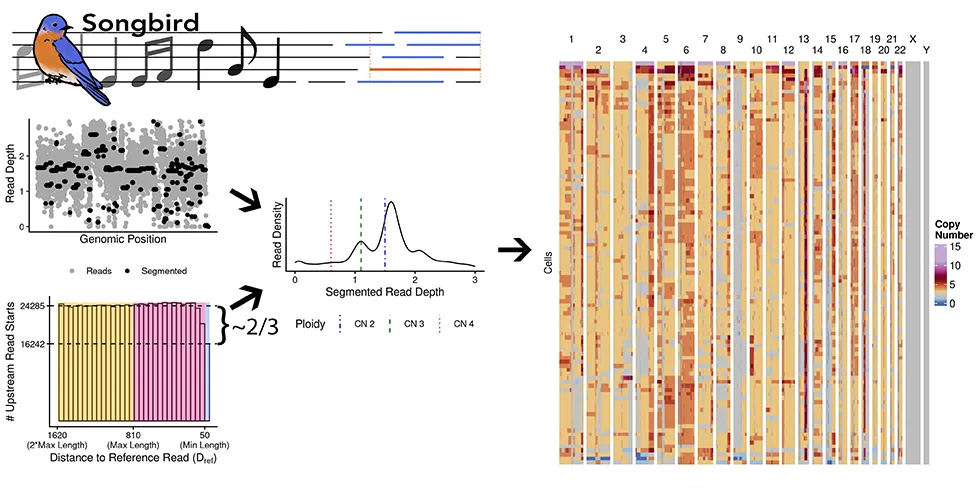
“Wavelet Based Whole Genome Doubling Aware Single Cell Copy Number Calling,” recently published in Nucleic Acids Research, introduces the computational tool Songbird and its applications. The paper includes IICD members Benjamin Wesley, Khanh Dinh, Simon Tavaré, and Karol Nowicki-Osuch among its authors.
Improving Single-Cell Copy Number Calling
Single-cell whole genome sequencing technologies have significantly progressed to provide increasingly detailed views of the mutations that shape cancer. Despite those improvements, researchers often recover only a fraction of genomic data. To better understand the mutational landscape of cancer cells, IICD researchers and collaborators developed Songbird, a flexible genome copy caller that exploits previously unused geometric features of data collected using single cell genome sequencing technologies to more accurately call copy number states of single cells.
Cancer cells frequently gain or lose sections of their genome as they evolve. With Songbird, researchers use wavelet transforms to identify likely genomic coordinates where the cell’s copy number changes. Then, using a fragment counting algorithm, Songbird estimates the cell’s true ploidy (how many complete sets of chromosomes are present in the cell). Finally, Songbird puts that information together, merging the true ploidy with the proposed genomic breakpoints, to identify a final copy number profile.
Understanding Copy Number Changes
With this critical information, researchers can reconstruct the copy number and estimate how many copies are in each region of the genome. The copy number provides a more complete picture of the changes within a cell, allowing scientists to potentially reconstruct the genomic changes that occurred as the cancer evolved.
Two such genomic structural variants, breakage fusion bridges and ecDNA, have been identified as drivers of treatment resistance in cancers and Songbird demonstrates enough sensitivity to recover these genomic lesions.
Thus, the immediate implications of Songbird are that it can help recover more subtle, but consistent patterns of copy number changes that can drive tumor formation. Furthermore, features of Songbird such as the ploidy estimation algorithm and sequencing cleanup criteria could help future copy number callers become more accurate and reliable.
Finally, Songbird demonstrates flexibility to multiple newer scWGS modalities, showing its potential as a robust tool going forward.
Expanding Songbird’s Applications
In the long-term, Songbird can lead to new insights about genomic history and evolution, and can help characterize copy number profiles in diseases with high copy number variability. “In the best case, we'd hope for larger adoption of Songbird to resolve the copy number profile in diseases that feature high copy number variability and a wide variety of structural variants,” explains Benjamin Wesley.
One disease the team would like to explore is Barrett’s esophagus, a pre-cancerous indicator of esophageal adenocarcinoma that has a relatively low rate of progression to cancer. Barrett’s esophagus features a diverse copy number profile while still remaining non-cancerous.
“Further afield we are curious about using Songbird's algorithm to call copy number profiles in single cell ATAC-seq data, opening the field to a much wider scientific community” Dr. Karol Nowicki-Osuch shares, referencing a sequencing technique that identifies accessible regions of the genome, and is commonly multiplexed with RNA sequencing and other sequencing modalities.
These research interests provide a preview of Songbird’s potential applications across different disease contexts and sequencing methods.
Publication Details
The paper was published in Nucleic Acids Research (DOI: 10.1093/nar/gkag960). The paper was led by Benjamin K. Wesley in collaboration with IICD members with Khanh Dinh (Columbia University), Simon Tavaré (Columbia University), and Karol Nowicki-Osuch (German Cancer Research Center) and the labs of Rebecca C. Fitzgerald (University of Cambridge) and Nicolas Robine (New York Genome Center).