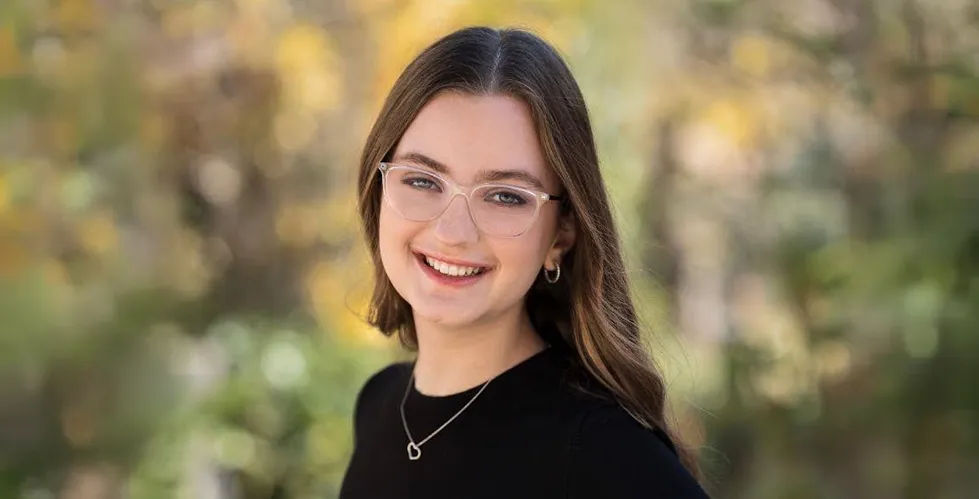
In 2024, undergraduate student Hadassah Mayerfeld arrived at the Irving Institute for Cancer Dynamics for her internship at our Summer Research Program. At that time, she was attending Yeshiva University’s Stern College for Women, pursuing her degree in Physical Sciences with a Concentration in Biochemistry. Under the mentorship of Drs. Bianca Dumitrascu and Andrew Blumberg, she would engage in computational research for the first time.
Since those early days as an undergraduate researcher, Hadassah’s academic journey has led her back to Columbia University, now as a first-year MS/PhD student in Biomedical Engineering, working in Dr. Michael Lipton’s Translational Neuroimaging Laboratory.
“My current research involves developing and refining MRI methods for application to mild traumatic brain injury (mTBI),” Hadassah explains, “and investigating the neuromechanics and pathogenesis of mTBI, laying the foundation for improved diagnostic tools and identifying mechanistic targets for treatment discovery.”
Recently, Hadassah received a competitive NSF Graduate Research Fellowship, which will allow her to continue her mTBI research, ultimately with the goal of developing imaging methods to characterize brain injuries and improving tools for clinical practice.
“Being named an NSF-GRFP awardee is an honor and a meaningful validation of work I've been passionate about since my undergraduate years,” she reflects. “The support and mentorship I've received along the way were instrumental in helping me translate my aspirations into concrete research questions and protocols, and encouraging me to pursue this opportunity and reach this milestone.”
The foundations of Hadassah’s research interests were shaped during her undergraduate experience, and expanded upon during the Summer Research Program. At IICD, her research bridged both mathematical and biological areas, in the true interdisciplinary spirit of the Institute.
That summer, Hadassah pursued a project focused on optimal transport theory for cell-type label transfer between similar cell types in different species.
“While OT is widely used to mathematically represent matching problems, I explored its performance and biological relevance when applied to scRNAseq data,” she describes. “I investigated how different embedding methods—both linear and machine learning approaches— impact OT’s ability to accurately identify similar cell-types across species.”
During her time at the SRP, Hadassah learned that “real impact comes not only from what we know, but from how effectively we communicate it.” Moving between disciplines and vocabularies during her internship has helped her to navigate research inquiries ever since.
Now, as a graduate student, she reflects on the privilege and responsibility of scientific knowledge. For future SRP interns and researchers of all kinds, she reminds us: “Keep asking not only what you can discover, but also what you can do with it.”