2024–2025 Seminar Series: A Year of Insight Across Disciplines
From exploring immune responses to advancing AI-powered genome tools, the 2024–2025 IICD Seminar Series offered a dynamic academic year of cutting-edge talks at the intersection of mathematical sciences and cancer research.
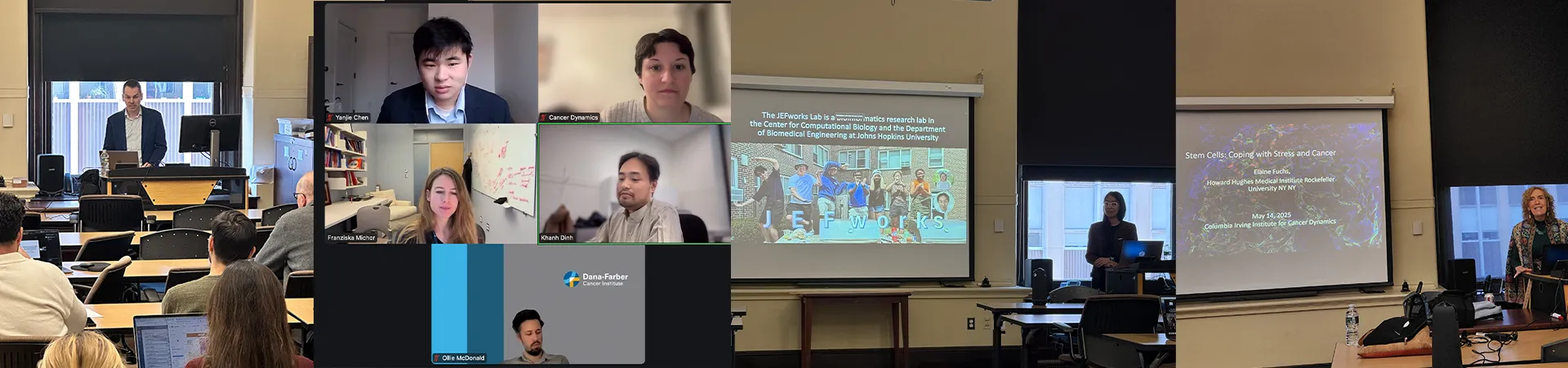
Held monthly from October through May, the seminar series welcomed leading experts from institutions including Stanford, Harvard, NYU, Johns Hopkins, and Columbia. Each session served as a platform to spark discussion and innovation across disciplines—from machine learning and spatial omics to tissue dynamics and developmental biology.
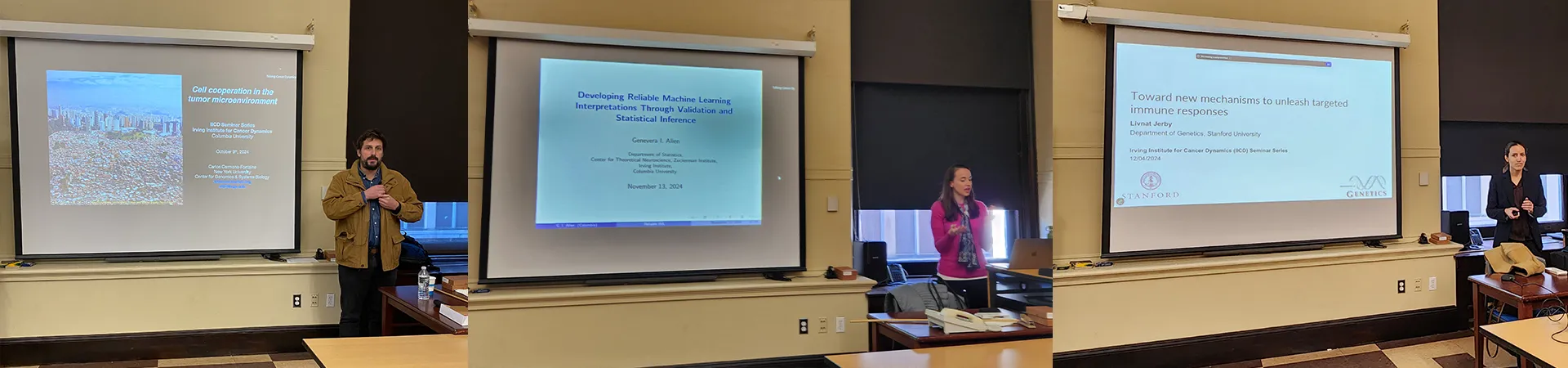
This year’s series launched in October with Carlos Carmona-Fontaine (NYU), who presented a compelling look at cooperation and competition among tumor cells. November’s seminar featured IICD core member Genevera Allen, who spoke on the importance of statistical inference in ensuring reliable machine learning interpretations in biomedicine. In December, Livnat Jerby (Stanford) shared new mechanisms for redirecting immune responses for therapeutic potential.
The spring lineup featured equally diverse and impactful topics. Highlights included Cole Trapnell (University of Washington) study on embryo-scale single-cell chemical transcriptomics Franziska Michor’s (Harvard/Dana-Farber) work on chemical transcriptomics, and Jean Fan’s (Johns Hopkins) approaches to comparative spatial omics data analysis. The series concluded in May with Elaine Fuchs (Rockefeller University), who discussed the role of tissue stem cells in stress response and cancer.
Through these monthly gatherings, IICD continues to foster dialogue and collaboration between the mathematical, biological, and clinical research communities. The Institute is grateful to all the speakers and attendees who made this year’s series a success.
Stay tuned for future events and updates via our IICD Seminar Series page.