
Columbia Researchers Map How SHP2 Mutations Reprogram Cells
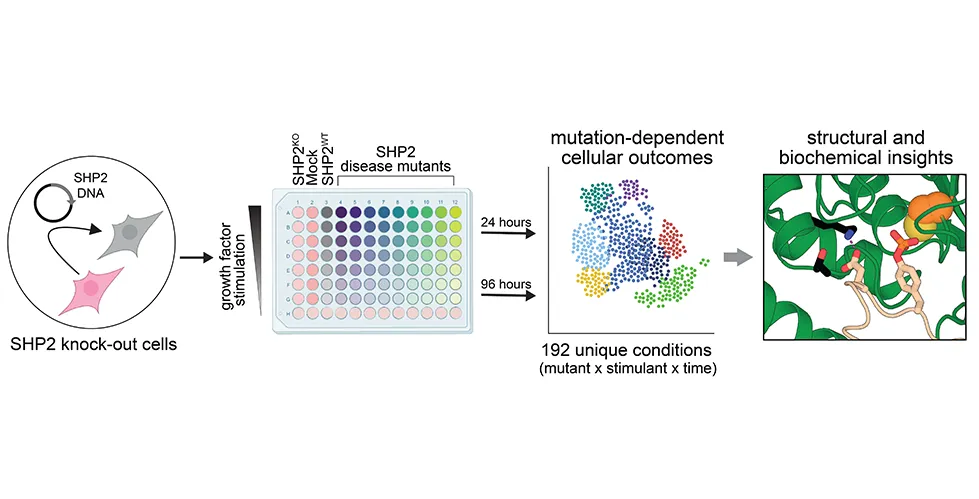
Using multiplexed single-cell sequencing, researchers from the McFaline-Figueroa and Shah labs uncovered how different disease-associated SHP2 mutations reshape cellular signaling and gene expression, offering new insights into cancer and developmental disorders. SHP2, a signaling enzyme involved in regulating cellular communication, is frequently mutated in diseases like leukemia and Noonan syndrome.
This study, recently published in Science Advances, was co-authored by Anne E. van Vlimmeren and Ross M. Giglio, and involved collaborators across multiple departments and Institutes at Columbia University.
Understanding SHP2 Mutations
The researchers sought to better understand how different SHP2 mutations alter cellular behavior. There are many disease-causing mutations in SHP2, each of which alters SHP2 activity in unique ways.
“Some mutations hyperactivate this enzyme, some change its overall shape, others inactivate the enzyme, others change what types of proteins SHP2 will interact with in the cell, and yet others change where SHP2 is localized in the cell,” explains Dr. Shah. “It is fascinating that one protein can be altered in so many ways and still point toward overlapping disease outcomes,” says Dr. McFaline-Figueroa.
A High-Throughput Approach to Cellular Signaling
The researchers approached the challenge of diverse mutations by generating an array of cells that expressed different SHP2 disease mutants. The engineered cells were then exposed to growth factor stimulation, allowing the researchers to compare how distinct SHP2 variants altered downstream cellular responses. Finally, researchers used multiplexed single-cell RNAseq to examine how the cells reacted to the growth factor.
“This approach allowed us to classify the cellular effects of SHP2 mutations in a way that was not previously possible, shedding new light on how mutations in this important enzyme cause disease,” says Dr. Shah. “By looking at the effect of mutations on gene expression, we could create a fingerprint of how each mutation changes cell behavior. Comparing those fingerprints lets us group mutations by their cellular effects and begin to understand variants whose disease mechanisms have remained unclear” explains Dr. McFaline-Figueroa.
Toward Mutation-Specific Therapies
The findings suggest that different SHP2 mutations may create distinct therapeutic vulnerabilities, raising the possibility of more personalized treatment strategies – particularly when considering the future of disease etiology and also of patient therapies.
“In this scenario, knowing what mutations exist in a patient could one day inform a therapeutic strategy to treat that patient. This could have implications for personalized medicine,” explains Dr. Shah.
Expanding the Platform
The researchers now hope to expand the platform to characterize a broader range of SHP2 mutants. While the study characterized roughly a dozen SHP2 mutants, over 50 pathogenic mutations have been found in different people. The Shah Lab has previously pursued other technologies to characterize disease-associated mutations, but a more high-throughput version of the experimental platform in this study could provide additional, deeper insights into SHP2-relevant cellular processes.
Furthermore, the researchers hope to refine the approach so it may be applied to more proteins. “We envision using the same strategy to explore how cells expressing different mutants in disease-associated proteins respond to clinically-relevant therapies,” shares Dr. Shah. “Notably, some of this work is already underway in the McFaline-Figueroa lab.”
Dr. McFaline-Figueroa says the same logic could extend beyond protein-coding mutations. “This type of high-throughput mutational characterization can also be applied to variants outside protein-coding regions,” he says. “For example, it could help us catalog how patient-associated changes in gene regulation contribute to disease and influence response to therapy.”