
From Paris to Columbia: A Q&A with Alliance Interns
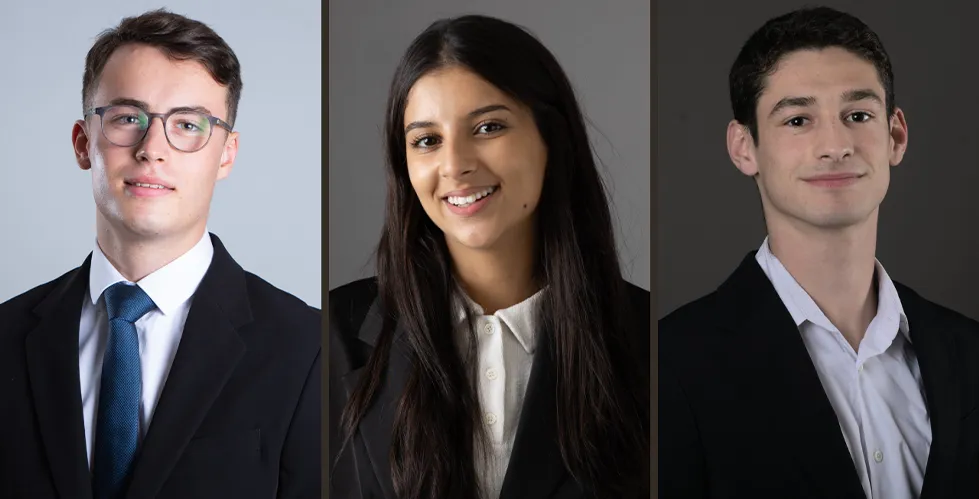
As their internships draw to a close, we’re celebrating the contributions of talented Alliance Program students who joined the Institute for Cancer Dynamics this spring. Through the Alliance Program—a collaborative initiative that brings master’s students from École Polytechnique to Columbia University—these interns spent four months immersed in interdisciplinary cancer research, working closely with IICD faculty on projects ranging from stochastic modeling to machine learning.
We caught up with three of our Alliance interns—Léandre Simon, Sara El Baghdadi, and Ethan Cohen—who shared insights into their research, challenges, and discoveries during their time at IICD.

Léandre Simon is a master's student in Applied Mathematics at École Polytechnique. He previously completed preparatory Mathematics, Physics, and Engineering Sciences classes at Lycée Aux Lazaristes. At the Institute, Léandre is working under the mentorship of Dr. Simon Tavaré, focusing on leveraging stochastic modeling, statistics, and machine learning to address healthcare challenges. His research aims to develop computational frameworks for understanding complex biological systems and improving data-driven approaches in medical research.
What initially drew you to the Alliance Program and a summer at IICD?
I was drawn to the Alliance Program because it offered a unique opportunity to live and work in New York City while being part of an exciting research environment. The application process felt accessible and well-structured, which made the program even more appealing. Most importantly, the subject matter, which is at the intersection of applied mathematics and healthcare/biology, is in line with my career goals.
Can you describe the research project you worked on and what you found most exciting or challenging about it?
My project focused on studying stem cell behavior in the Drosophila ovary using data from live-imaging provided by the Kalderon lab. I developed a mathematical framework to perform statistical inference on this biological data. The biggest challenge was making sure the models accurately captured the biological reality, which required constant back-and-forth with the biology experts. It wasn't always easy, as we often had to bridge gaps in understanding between our different fields."
How did working at the Institute differ from your past academic or research experiences?
Before this, I had done research in both academic and company settings. What made this experience different was its international dimension, working in English and engaging with a diverse group of researchers. I also appreciated the many seminars, workshops, and informal discussions, which offered constant learning opportunities and a strong sense of community.
What is one unexpected thing you learned?
One surprising thing I learned was how research on fruit flies can significantly inform our understanding of human biology and diseases like cancer. I didn’t expect such a small organism to give such useful insights into basic biological processes.
What’s next for you after this internship?
After this internship, I’m pursuing a master’s degree in Applied Mathematics at EPFL in Switzerland, where I plan to take several biology-related courses. This experience has solidified my interest in healthcare and biotech, and has strengthened my motivation to pursue a career in this field.
Sara El Baghdadi is a master's student in Applied Mathematics and Data Science at École Polytechnique. She previously completed preparatory Physics and Chemistry Engineering Sciences classes at Lycée Sainte-Geneviève. Before joining Columbia, Sara completed research projects in computational biology and data science, including work on modeling high-dimensional data and time-series forecasting. At IICD, Sara is working under the mentorship of Drs. Simon Tavaré and Khanh Dinh to investigate clustering mutations based on Variant Allele Frequencies to infer cancer growth models. Her research aims to enhance predictions of patient outcomes and tumor dynamics, leveraging mathematical modeling and data science to deepen our understanding of cancer progression.
What initially drew you to the Alliance Program and a summer at IICD?
Coming from École Polytechnique in Paris, I was eager to step outside a purely academic setting and try an interdisciplinary, international environment. The Alliance Program’s mission at IICD felt like the perfect bridge between my training in Applied Math and my passion for biomedical impact. Plus, the chance to live and work in New York City, with its fast-paced energy and incredible diversity, was impossible to pass up.
Can you describe the research project you worked on and what you found most exciting and/or challenging about it?
My main focus was extending DECODE, a computational pipeline for inferring tumor subclonal architecture from exome sequencing data. I helped with implementing the pipeline, improving model selection, and running it on hundreds of samples. The most exciting part was watching it handle the variety of samples, and then crafting cool, stylish plots to visualize DECODE’s results. The biggest challenge was doing the entire project in R when I’m much more comfortable in Python. Learning new R packages and adapting my coding habits pushed me out of my comfort zone, but I ended up with a much stronger toolkit.
How did working at the Institute differ from your past academic or research experiences?
At IICD, instead of semester-long assignments, deliverables were calibrated to lab schedules and team meetings, so I learned to iterate quickly, solicit feedback from collaborators, and ensure my code was robust enough. The daily cross-talk with other researchers was far more dynamic than the typical solo coding marathons I’d grown used to.
What is one unexpected thing you learned about cancer research, New York City, or yourself during your time here?
Living in New York and sharing an apartment with other interns was eye-opening. We cooked together, hunted for cheap eats, and explored different neighborhoods on weekends. That mix of work and city life taught me how much I enjoy new routines and living with people from around the world.
What’s next for you after this internship, and how has this experience shaped your path forward?
This fall, I’ll start a Master of Science in Stanford’s ICME department, where I hope to work as a research assistant in cancer bioinformatics. I’m also thinking about a PhD later on… My summer at IICD confirmed that combining computation and biology is exactly where I want to be.
Ethan Cohen is a master's student in Applied Mathematics at École Polytechnique. He previously completed preparatory Mathematics and Physics classes at Lycée Louis-Le-Grand. In this internship, Ethan is working with Drs. Simon Tavaré and Khanh Dinh, exploring machine learning and statistical modeling to address health-related challenges. His research involves developing mathematical models to better understand complex biological processes with applications in cancer dynamics and disease progression.
What initially drew you to the Alliance Program and a summer at IICD?
I wanted to apply my skills in maths and data science to the study of cancer. So, as a French student, the chance to spend a summer at the IICD in New York City felt like a perfect fit.
Can you describe the research project you worked on and what you found most exciting or challenging about it?
My project focused on modeling the evolutionary dynamics of cancer, particularly the role of chromosomal instability events such as whole-genome duplications and multipolar divisions. I worked on extending a simulation framework to capture how these genomic alterations influence tumor evolution and clonal selection. One of the most exciting aspects was developing new simulation modules to represent biological processes that are rarely modeled computationally, like multipolar mitoses. I also loved the back-and-forth between theoretical reasoning and empirical validation through large-scale simulations.
How did working at the Institute differ from your past experiences?
At IICD, I found a fantastic balance between autonomy and mentorship. While I was given full ownership of my project, I also had the chance to collaborate closely with researchers and benefited from regular discussions with my advisor, Dr. Khanh Dinh. Unlike some past experiences where research was more theoretical or isolated, here I was able to connect mathematical ideas directly to biological insight, which made the work feel intellectually satisfying.
What is one unexpected thing you learned?
One unexpected realization was just how complex evolutionary dynamics in cancer can be. Even seemingly rare genomic events like multipolar divisions can drastically reshape the trajectory of a tumor.
What’s next for you after this internship?
I’ll be starting a master’s in Computational and Mathematical Engineering at Stanford University. My experience at IICD has reinforced my passion for interdisciplinary research, particularly using advanced mathematical and computational methods to tackle complex real-world problems!