
Postdoc Profile: Apoorva Singh, PhD
Postdoc Profiles is a series that spotlights postdoctoral researchers, and their work, across IICD and its affiliated groups.
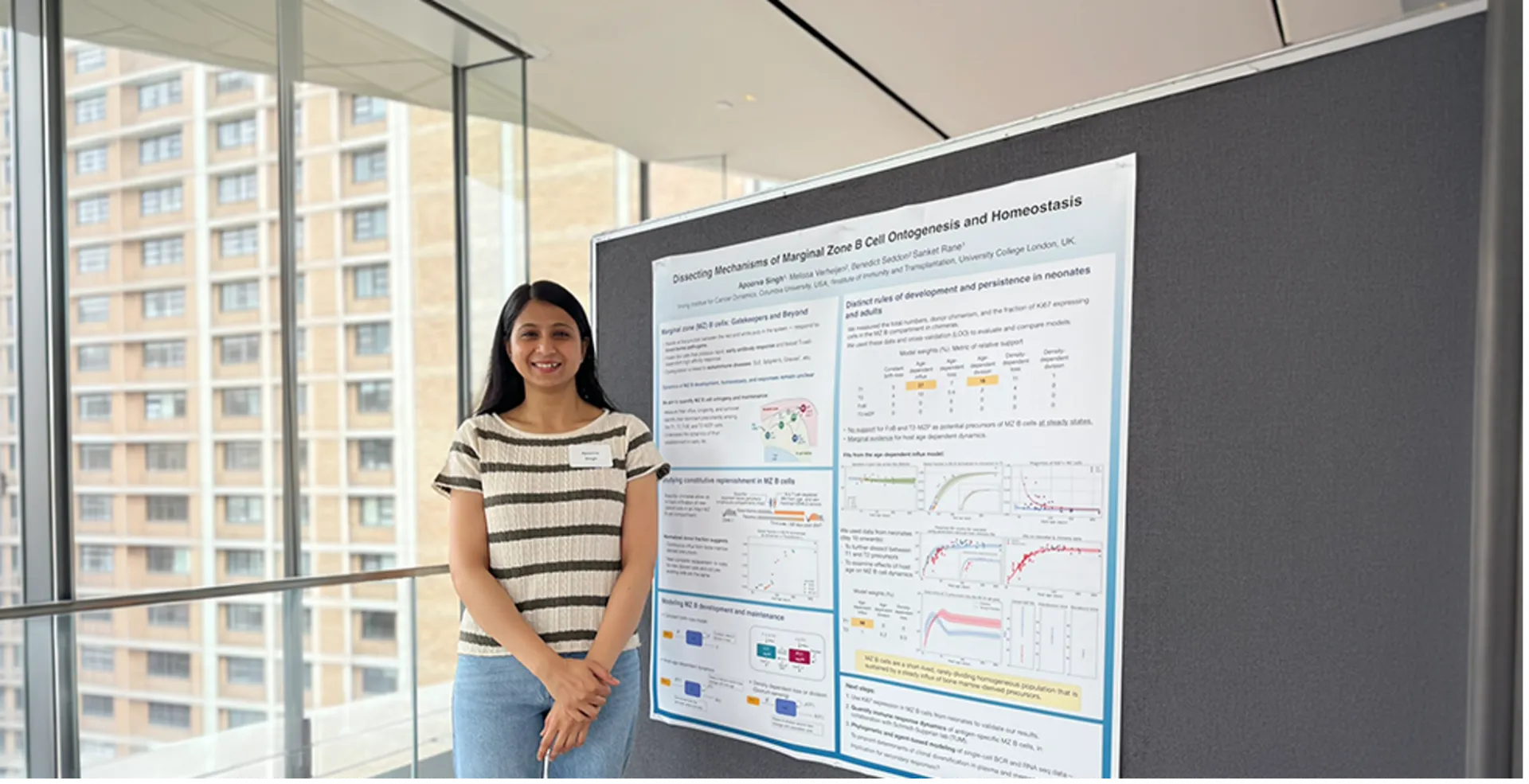
Dr. Apoorva Singh is a Postdoctoral Research Scientist at IICD, co-mentored by Dr. Andrew Yates and IICD Director, Prof. Simon Tavaré. Her work sits at the intersection of mathematics and immunology. Trained as a pure mathematician, she is now applying mathematical modeling techniques to better understand the immune system, bringing rigorous quantitative approaches to questions in computational immunology.
Apoorva’s passion for science was shaped by her professors, who introduced her to the world of pure mathematics. What began as an appreciation for mathematics as a school subject evolved into a fascination with its depth, complexity, and beauty. Through her studies, she learned the importance of rigorous proof and logical reasoning, principles that continue to guide her research today.
“My professors taught me that in this field, there’s no room for guessing, you have to prove everything rigorously,” Apoorva explains. “That way of thinking and precision continues to shape my research as I apply mathematical approaches to understand the complexity of the immune system.”
Today, that mathematical mindset drives her work in quantitative immunology, where she is applying her expertise to the study of the immune system. At IICD, she uses mathematical modeling and Bayesian statistics to study how immune cells develop, are maintained, and change over time to uncover the mechanisms that govern immune system dynamics.
For Apoorva, one of the most exciting aspects of research is the opportunity to continuously learn and solve challenging problems. “I’m constantly learning about how the immune system truly works and using mathematical modeling techniques to better understand it,” she says. “The excitement of uncovering new insights, solving intricate problems, and contributing to a field that merges two powerful disciplines keeps me motivated.”
One of the most memorable moments in Apoorva’s research journey came during her doctoral work. She spent a significant amount of time struggling with a difficult thesis problem focused on characterizing the invariant subspaces of a multiplication operator on a class of Hardy spaces. When she finally solved the problem, however, the experience left a lasting impact.
“When I finally cracked it, the sense of accomplishment was incredible,” she reflects. “It was a powerful reminder that in research, you're always immersed in the problem-solving process. It taught me resilience and the importance of persistence.”
Alongside the challenges of research, Apoorva has also navigated societal barriers throughout her academic journey. Growing up in an environment where girls’ education was not always prioritized, she sometimes questioned her abilities and place in the field. Over time, she learned to focus on her goals and seek out mentors who were encouraging and supportive.
“The future for women in science and technology is incredibly promising,” she says. “I’ve been inspired by many accomplished women scientists making significant breakthroughs across all areas of science. With mutual support, we can overcome challenges and continue to advance knowledge together.”
Reflecting on her own experiences, Apoorva hopes to encourage the next generation of women scientists to be confident. “No matter where you start or where you are in your research journey, stay immersed in your work and keep striving to understand more,” she advises. “Find mentors who can help you grow your confidence and guide you through challenging times. Embrace challenges, especially when self-doubt creeps in, and pursue your goals with determination.”
Throughout her career journey, Apoorva has brought a unique perspective to research. Her commitment to lifelong learning and her determination have enabled her to transition from pure mathematics to biology, and to be a vital part of the Institute’s interdisciplinary community.