
A TRENDY New Approach to Modeling Gene Regulation with AI
Dr. Yue Wang, Associate Research Scientist at the Herbert and Florence Irving Institute for Cancer Dynamics and in the Department of Statistics at Columbia University, has developed a novel approach to improve the accuracy and interpretability of gene regulatory network inference using deep learning. The results were recently published in Bioinformatics.
Understanding the Challenge
Within cells, genes often regulate each other through complex interactions. These regulatory relationships are fundamental to how cells grow, adapt, and respond to their environment. However, directly observing these gene-gene interactions is extremely difficult. Scientists must instead infer them from large gene expression datasets, a challenge that has persisted across the fields of genomics and computational biology.
A TRENDY New Approach
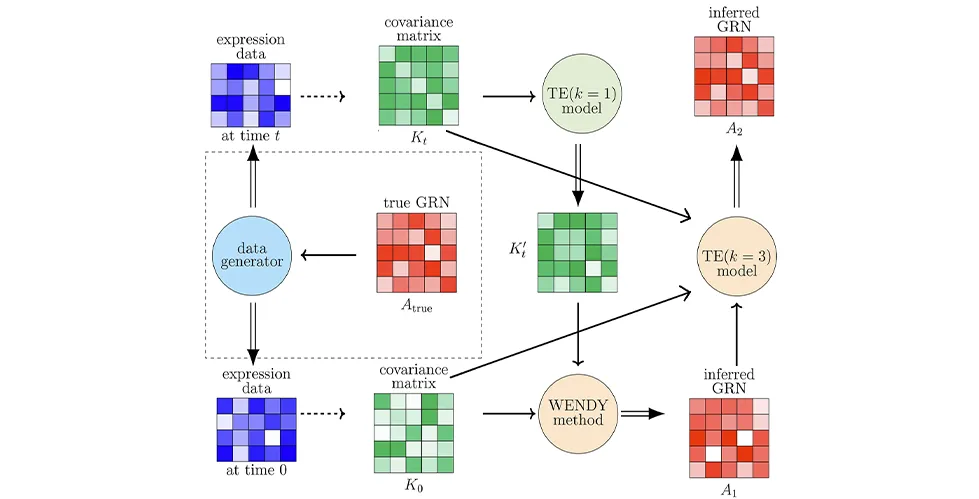
To address this, Dr. Wang and collaborators introduced TRENDY, a deep learning-enhanced method that builds on a previous model called WENDY. While WENDY offered a mathematically sound approach to inferring gene regulations, it relied on certain approximations that introduced errors. TRENDY uses a transformer-based deep learning architecture to reduce these errors, significantly boosting performance.
“When we tested TRENDY against 15 other inference methods, it ranked first in terms of accuracy,” said Dr. Wang. “What’s even more exciting is that unlike many deep learning models, TRENDY also offers improved interpretability, helping us understand not just what the model predicts, but why.”
Scientific and Practical Impact
By improving the accuracy and transparency of gene regulatory network inference, TRENDY opens the door to several impactful applications. Researchers can use it to uncover novel relationships between transcription factors and their target genes, gain deeper insight into cellular processes—such as cell differentiation, response to stress, and disease progression—and generate new hypotheses for laboratory validation, for instance identifying key regulatory genes in cancer networks.
What’s Next
Building on this work, Dr. Wang is now developing additional mathematical approaches for inferring gene regulations and exploring how large language models, like those used in natural language processing, can further enhance these methods.
As data in genomics grows ever larger and more complex, tools like TRENDY mark a crucial step in transforming complex data into actionable, life-saving insights.
Publication Details
The paper, co-authored by Xueying Tian, Yash Patel, and Yue Wang, is published in Volume 41, Issue 6 of Bioinformatics (DOI: 10.1093/bioinformatics/btaf314). Notably, Yash Patel was a mentee of Dr. Wang during the 2024 Summer Research Program at IICD.