
Vicković Lab Publishes a New Study on Colon Aging in Nature Biotechnology
The lab of Dr. Sanja Vicković, Assistant Professor of Biomedical Engineering (in the Herbert and Florence Irving Institute for Cancer Dynamics), has developed a new computational framework to investigate cell and tissue organization in pathology. The work, recently published in Nature Biotechnology, was conducted in collaboration with the laboratories of Aviv Regev and Richard Bonneau at the Broad Institute of MIT and Harvard, New York University and the Flatiron Institute, both of whom are now at Genentech.
Unraveling the Complexities of Colon Aging
Aging is a universal process that profoundly influences the structure and function of our organs, yet many of the molecular mechanisms behind these changes remain elusive. To address this, Dr. Vicković and her collaborators set out to create an unprecedented cellular and spatial atlas of the colon, charting how tissues and cell types change across the lifespan.
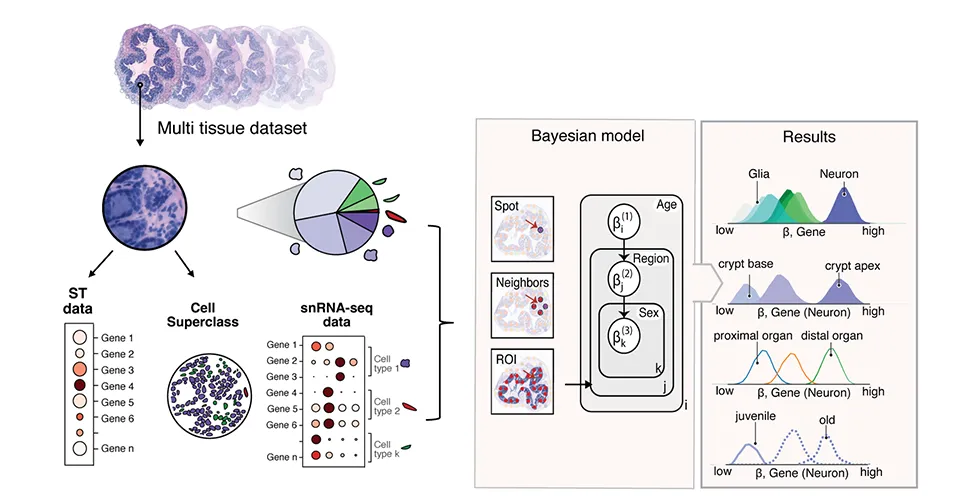
Their team profiled nearly 1,500 mouse gut tissues using advanced spatial transcriptomics and analyzed ~400,000 single nucleus RNA-seq profiles spanning three anatomical regions and 11 age groups. This ambitious effort resulted in one of the most comprehensive datasets to date on colon aging, providing a multi-dimensional view of how aging impacts tissue structure and molecular circuitry.
Introducing cSplotch: A New Era in Spatial Analysis
A major innovation from the study is the development of cSplotch, a novel computational framework designed to model spatially resolved cellular expression. “By leveraging histological features, cSplotch can share information across tissue samples and data modalities, enabling researchers to identify subtle but important patterns associated with age, tissue region, and sex,” explains Vickovic.
Through this new framework, the researchers mapped cellular and molecular gradients along the adult colonic tract and crypt axis, and identified multicellular programs specifically linked to aging in the large intestine.
Why This Matters
Understanding how aging reshapes the colon at a cellular and molecular level has critical implications. Not only for basic biology, but also for diseases like colorectal cancer and inflammatory bowel disease, which become more prevalent with age. “Our integrative, multi-modal approach offers a new blueprint for investigating how complex tissues change over time, with broad applications for cancer dynamics and regenerative medicine,” adds Vickovic.
Looking Ahead
Dr. Vicković’s work exemplifies the IICD’s mission to push the boundaries of cancer and systems biology through innovation, collaboration, and the development of new computational tools. Read the full paper: https://www.nature.com/articles/s41587-025-02830-6