
Bridging Biology and Biomechanics: The Dumitrascu Lab’s New Computational Framework Illuminates Tissue Development
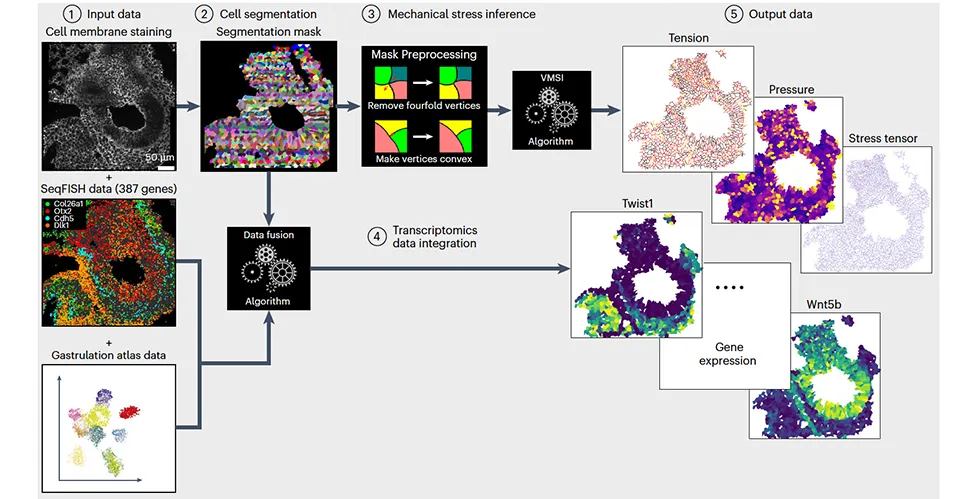
Bianca Dumitrascu, PhD, Assistant Professor of Statistics and Herbert and Florence Irving Assistant Professor of Cancer Data Research, has published a new study in Nature Methods titled “A computational pipeline for spatial mechano-transcriptomics”. In collaboration with Adrien Hallou*, Ruiyang He*, and Benjamin D. Simons, Dr. Dumitrascu introduces a novel computational framework that integrates spatial transcriptomics with mechanical force inference. This approach provides an unprecedented view of how physical forces and gene expression work together to shape tissue development.
New Insights into the Mechanics of Tissue Development
“Our group is fundamentally interested in morphogenesis—how cells acquire different fates while coordinating to build functional tissues and organs,” explains Dr. Dumitrascu. “Cells don’t act in isolation. They interact with their environment and respond not only to chemical cues but also to physical forces.”
This is the first computational approach to directly model mechanical forces alongside gene expression data at the single-cell level. By applying this model to spatial transcriptomics data from developing mouse embryos, Dr. Dumitrascu’s team uncovered both known and novel mechanosensitive genes that play crucial roles in defining tissue boundaries and cell fate decisions.
Why It Matters
Their findings are a breakthrough for both developmental biology and cancer research. Mechanical forces are key players in tissue patterning, but until now, researchers lacked the tools to study these forces alongside gene expression in high resolution.
“This framework helps bridge genomics and mechanobiology,” says Ruiyang He, a PhD student and co-author of the study. “It creates a shared language for researchers in both fields, which is critical for understanding complex processes like cancer progression, wound healing, and tissue regeneration.”
The Power of Collaboration
Dr. Dumitrascu credits the success of the project to interdisciplinary collaboration and the contributions of co-first author Ruiyang He. Ruiyang began this work as an undergraduate at Cambridge and has since joined Columbia as a graduate student, co-supervised by Dr. Dumitrascu and Dr. Sanja Vickovic. “Ruiyang has demonstrated an incredible ability to master spatial statistics, image processing, and computational modeling,” she says. “His work has been instrumental in bringing this project to life.”
Looking Forward
By integrating physics, biology, and statistical machine learning, Dr. Dumitrascu’s lab continues to push the boundaries of how we understand living systems. The recent MIRA R35 award will allow Dr. Dumitrascu’s team to expand their current research, extending their computational framework to 3D spatial and spatio-temporal data. Future applications will include self-organizing processes like wound healing, regeneration, and tumor microenvironments.
Dr. Dumitrascu is poised to make even greater strides in uncovering the interplay between mechanical forces and gene expression—insights that could lead to new therapeutic strategies in cancer and regenerative medicine.
🔗 Nature Methods publication: DOI: 10.1038/s41592-025-02618-1